Giant Step
Richard Clar
Giant Step is a personal response to an event I personally witnessed in 1969 and I wanted to use my creativity to pay tribute to those who took part in the Apollo program, and especially Neil Armstrong for what he did on that momentous day. I wanted the art to say something about the moon itself, about the first humans to set foot on the moon. Think how many living beings have observed the moon for eons…and now we have made a number of trips to the moon and back.
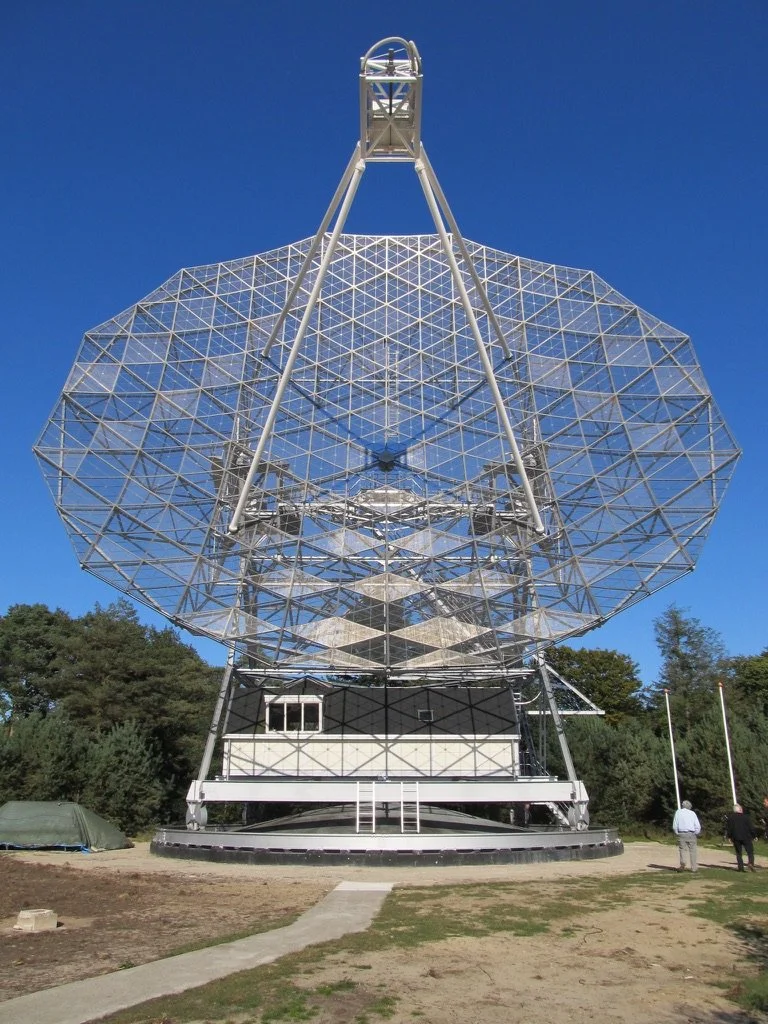
August of 2015, Daniela de Paulis, Italian artist, colleague and visual moonbounce pioneer, presented me with a creative challenge I couldn’t refuse. She invited me to use the 25-meter Dwingeloo radio dish in the Netherlands (Fig. 1) to create a visual moonbounce artwork. My interest was piqued after hearing about an earth-moon-earth bound (EME).
The moonbounce was invented in 1940 during World War II by an engineer at the U.K. Post Office Research Station, William J. Bray. The problem was how to keep Morse coded messages from being intercepted by the Germans. The ingenious answer was to use two radio telescopes in different locations. One would transmit the message, bouncing it off the moon, and the other would catch it on its return. The crucial factors were the moon’s position relative to Earth, the location of the radio transmitter and the alignment of the receiving antenna. And with that, the dots and dashes of critical messages could be sent and retrieved without detection.
As an artist, Daniela de Paulis, recognized that while bouncing messages back and forth off the moon was brilliant technology, she began working with radio engineer, Jan van Muijlwijk to develop something more. Together, they pioneered what is now called, Visual Moonbounce, which allowed de Paulis to send images to the moon, and rebound them back.
For me, it was important to find a more innovative way to use the moon than just being a backboard to ricochet images back and forth. I wanted to make a more meaningful statement about the moon itself. I began researching Apollo 11 within the historic archives at NASA Headquarters. What was clear was that all of the Apollo Missions had extensive documentation along with meticulous notes taken by the astronauts during the flight and while on the lunar surface.
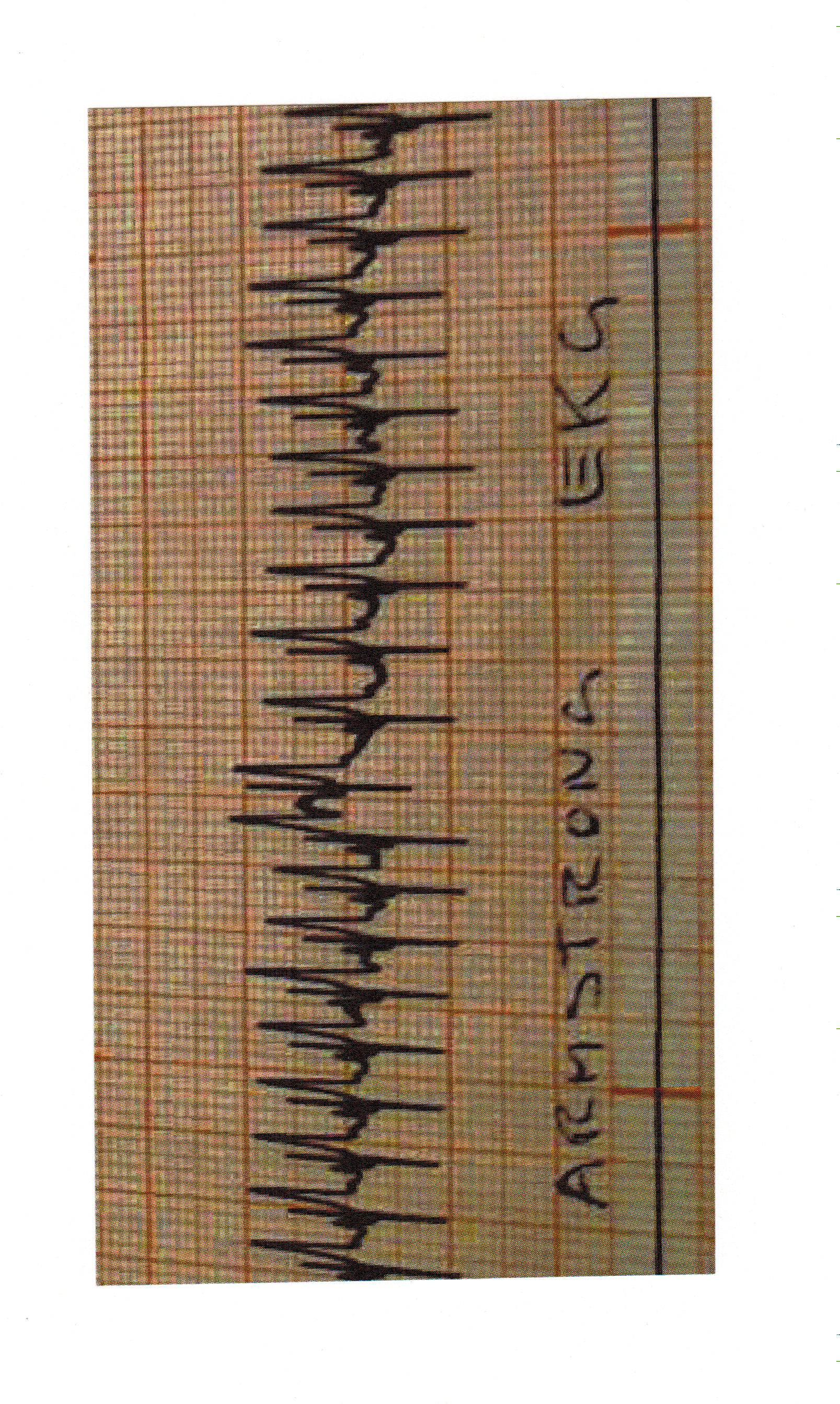
I then came across a nugget of pure gold when I unearthed a 2-D Electrocardiogram (EKG) of Neil Armstrong’s heartbeat as he took his first step on the moon (Fig. 2). As I contemplated the waves on this historic printed EKG, my first thought was: there’s music in those waving EKG lines. That was the beginning of Giant Step, which would be my artwork celebrating Neil Armstrong’s first step on the moon.
I then reached out to Dr. Ryan Compton, whose specialty was the sonification of data. Working with the 2-D EKG, Dr. Compton created a two-minute single tone from the Armstrong EKG.
For Giant Step, to truly exemplify this momentous occasion in human history and pay appropriate homage, I contacted, Roberto Miranda, Los Angeles double-bass jazz musician and UCLA professor. What sets jazz apart from other forms of music is its improvisational elements. I asked Miranda to use the two-minute EKG tone as a means to lift off and inspire his musical improvisation.
Roberto recorded two soulful tracks: over Compton’s single tone EKG, and Neil Armstrong’s famous words: “That’s one small step for man, one giant leap for mankind.” And with that, Armstrong’s beating, very human, heart became the representation of one of humanity’s greatest achievements.
The Apollo 11 moon landing was certainly an historic first for the American space program, but Armstrong knew that stepping foot on the lunar surface was bigger than that, and the words he spoke as the planet listened were meant for all of humankind. I wanted to make sure they continued to reverberate and inspire.
On September 26, 2015, at the Dwingeloo Radio Observatory in the Netherlands, just before a Super Blood Moon was about to take place, we gathered in the control room of the Dwingeloo Radio Telescope to launch the Giant Step moonbounce.
Fig. 1. Dwingeloo Radio Observatory, The Netherlands. Photograph Jan van Muijlwijk.Fig. 2. Neil Armstrong EKG upon his first step on the moon. Photo: NASA HQ.Four years later, on July 21st 2019, at precisely 02:56:15 UTC, the exact time Armstrong took that first step on the moon fifty years earlier, we performed another Earth-Moon-Earth (EME) moonbounce of that Apollo 11 landing. Again, the transmission carried the Giant Step sound file of Neil Armstrong’s words, heartbeat and the EKG tone. And as it had been designed nearly 80 years earlier, the radio telescope did its part sending out the signal and the moon did what it does, reflecting back the rays that hit it and returning the signal back to Earth carrying both image and audio files.
At the exact moment the Dwingeloo Observatory sent off the Giant Step Moonbounce, 1,440 kilometers away, at the Cote d’Azur Observatory Laser-Ranging Station near Grasse, France, I had arranged for another type of transmission to take place.
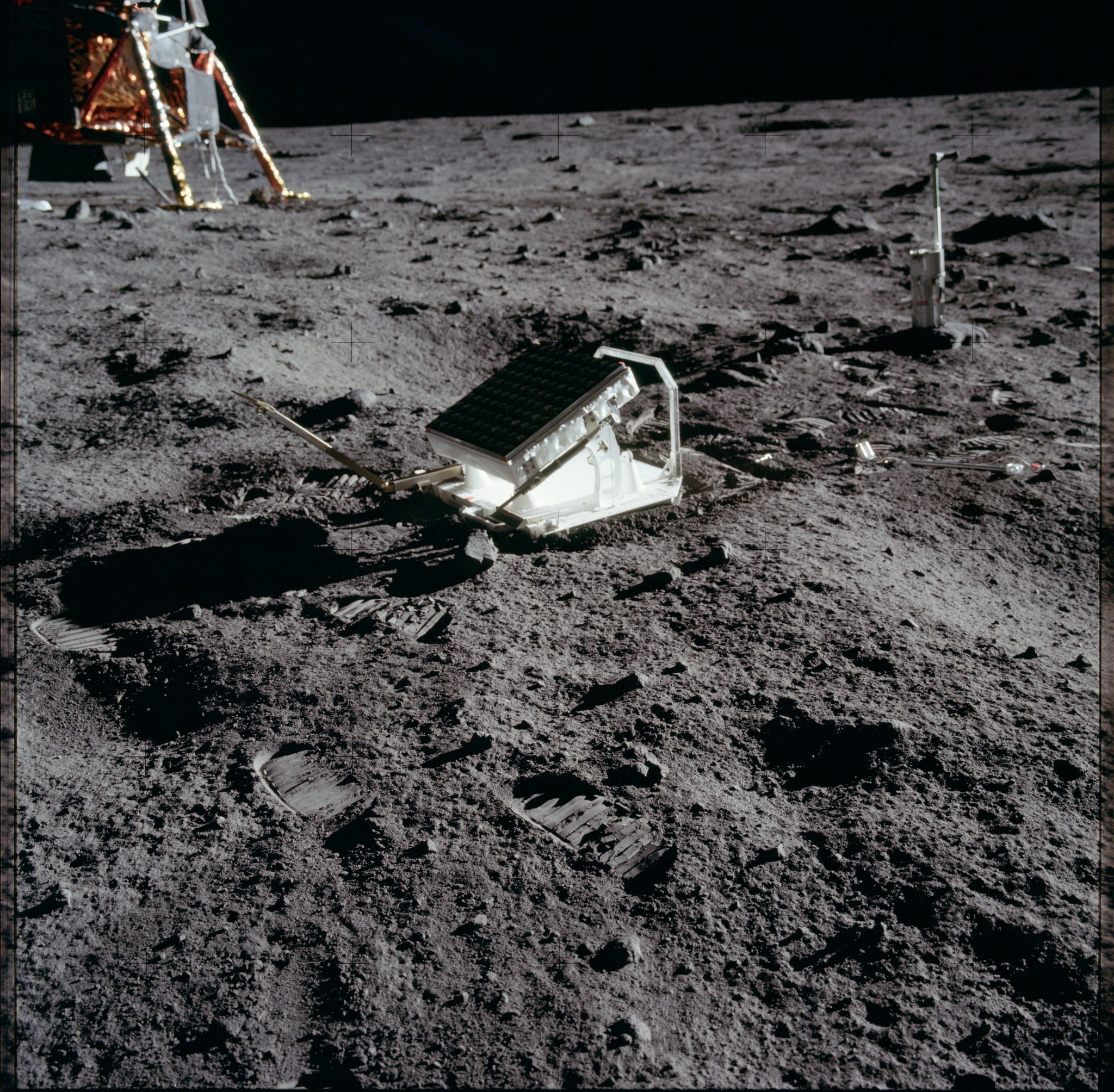
Back in 1969, as Armstrong and Buzz Aldrin leapt across the lunar surface, one of the last tasks they performed before packing up and leaving the moon was to place a retroreflector on the moon’s surface, in close proximity to the Lunar Lander.
A unique feature of the Apollo 11 retroreflector (Fig. 3) was that it caused light striking it, from any angle, to reflect back to earth in a parallel path. The scientific purpose of these retroreflectors was to enable a laser-ranging observatory to fire a laser beam that would strike the retroreflector and return a small portion of the photons from the beam back across space to its source. And even though what would be received was just a fraction of the initial output, it was enough to provide a very accurate measurement of the distance between earth and the moon.
Fig. 3. Apollo 11 retroreflector. Image credit: NASA.With the 50th Anniversary of Apollo 11 approaching and preparations already underway in the Netherlands for the radio telescope bounce, another idea dawned on me. I could also use a laser-ranging observatory to fire its green laser at the Apollo 11 retroreflector, and have it pulse in Morse code, “That’s one small step for man, one giant leap for mankind.”
When it was confirmed that the concept was valid, I set out to find the best location for this green laser transmission and discovered it was from the Côte d’Azur Observatory’s Laser-Ranging Station, near Grasse, France.
As with the radio telescope moonbounce, the plan was to have the laser transmission also occur at 02:56:15 UTC on July 21. In this instance, I would be returning Armstrong’s words to almost the exact spot where he walked 50 years ago. It made so much sense, it was almost too good to be true. Unfortunately, because of the laser-ranging’s narrow frequency band, 10 Hz, it was not possible to transmit anything other than a Morse coded message.
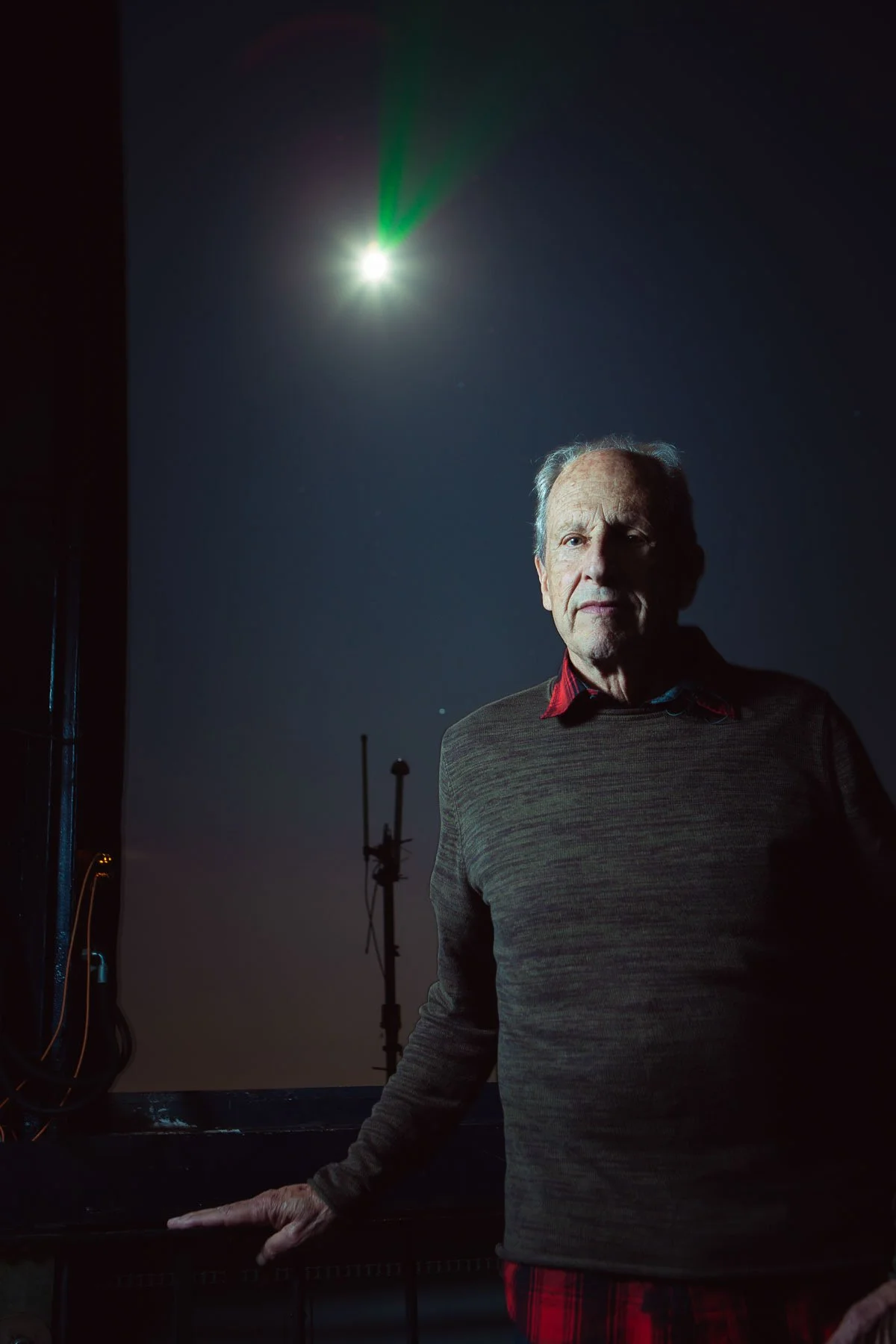
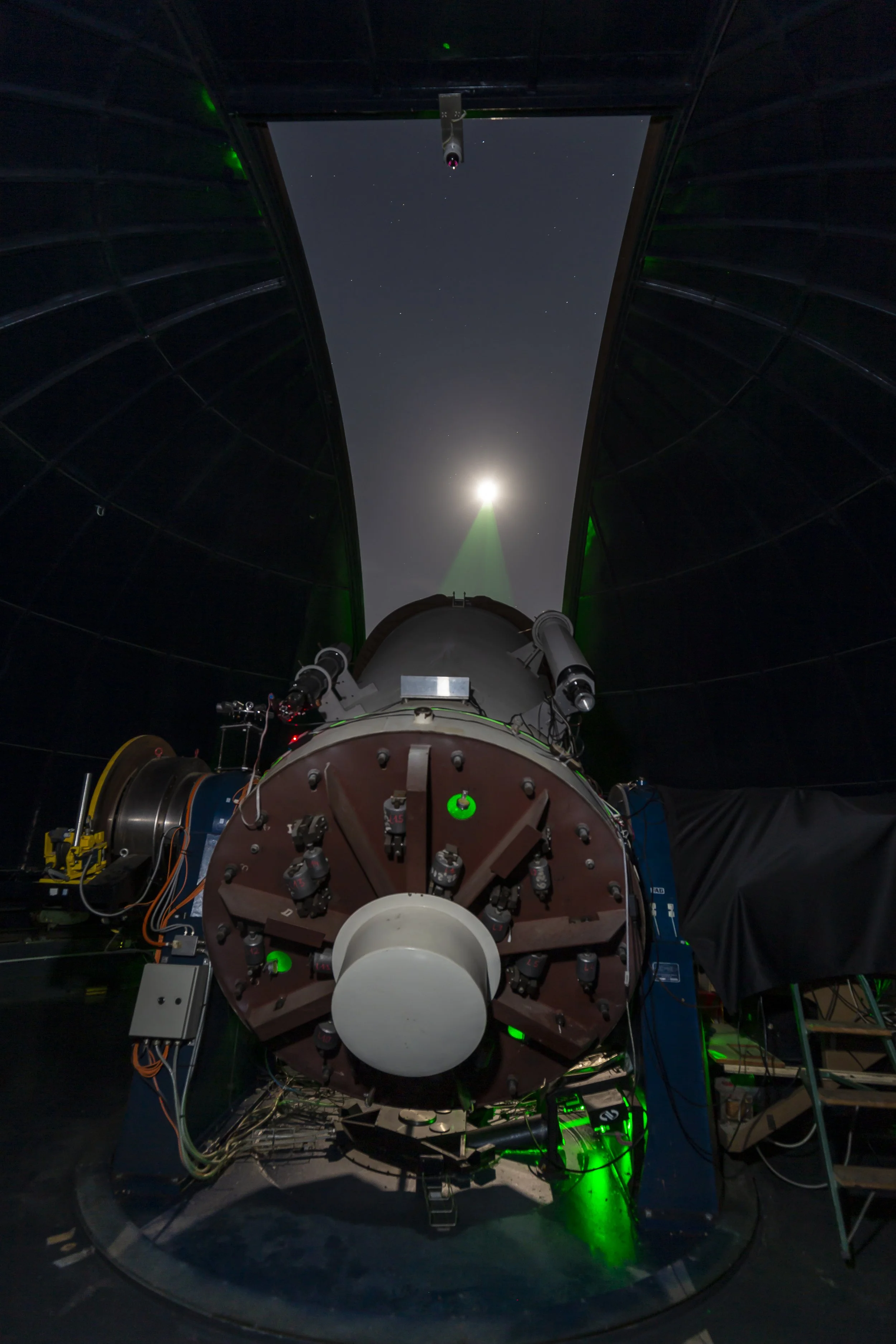
At precisely 02:56:15 UTC, the moonbounce commenced in Dwingeloo and the brilliant green laser at the Côte d’Azur observatory beamed out across the heavens, marking a direct path, 238,900 miles, to the retroreflector placed 50 years previously on the lunar surface (Fig. 4, Fig. 5).
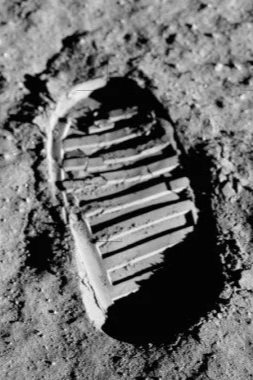
Both events occurred exactly as planned. From Dwingeloo, the heartbeat sound of Neil Armstrong’s EKG, the single tone created from that EKG, an image of Armstrong’s footprint (Fig. 6), and Armstrong’s resounding words were all successfully bounced off the face of the moon and back to earth. While simultaneously, 1,400 km away, the laser beam at Côte d’Azur sent out Armstrong’s coded message to within feet of where he had originally spoken them.
Fig. 4. Richard Clar inside the Côte d’Azur Laser Observatory dome as green laser beam strikes the moon. Photograph Rebecca Marshall.Fig. 5. Green laser beam as it strikes the moon from the Côte d’Azure Laser Observatory dome. Photograph Rebecca Marshall.Fig. 6. Moonbounced photo Apollo 11 astronaut footprint. Image by Dwingeloo Radio Observatory.Art, for me, has always been a way of breaking through the limitations and boundaries of the world I encounter. Finding new space to bring people together in a positive way to celebrate that all forms of art exist. There’s a word that I learned when I was studying ceramics and glaze technology, that in many ways has been a metaphor for my work in outer space, eutectic. It means fuses easily. It describes a process in which certain materials melt together and combine. They actually melt at a lower temperature than the melting point of any of the individual materials that are being combined. It’s almost magical, alchemical.
Art has always been my means of bringing different people together so that this eutectic process can take place. It’s a place where we can all fuse easily, recognize our interdependence and join together without raising the temperature of the planet.