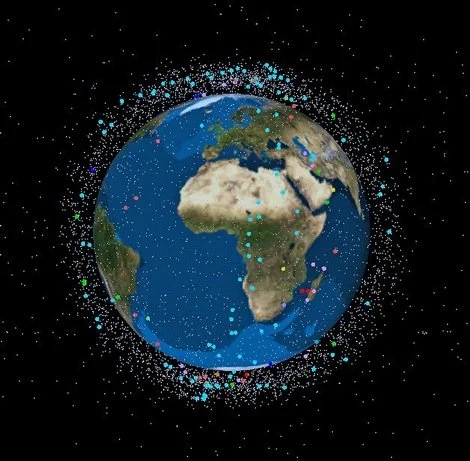
Image credit: The Naval Research Laboratory
COLLISION II:
An Orbital Debris Constellation Sculpture
Richard Clar 2003
COLLISION II is a dynamic site-specific orbital debris sculpture in Sun-synchronous orbit at an altitude of 450 to 900 kilometers above Earth. Richard Clar has been intrigued by the problem of orbital debris in space since the early ‘90s. Learning that the U.S. Space Command tracks over 10,000 of these orbital debris objects, and that the orbits of each of these objects is known and predictable, he envisioned an artwork from this orbital debris in space on a scale previously unheard of. COLLISION II was created in collaboration with the Naval Research Laboratory (NRL) and French composer Marc Battier in 2003.
Background
Space. It's a dangerous place--an extreme environment hostile to human beings. The launch in 1957 of Sputnik, the first artificial satellite, heralded not only the beginning of the space age, but what would ultimately become another danger in space: orbital debris.
Forty-six years and thousands of launches later, the near-Earth environment of space has become heavily populated with orbital debris. The heaviest concentration of orbital debris is in low-Earth orbit, becoming less dense as it progresses out to geosynchronous orbit. These orbital debris objects consist of spent rocket bodies, various space hardware, non-functioning satellites, and fragments from explosions. According to information provided by the Aerospace Corporation in California, there have been more than 124 verifiable breakups in space. Collisions and explosions are usually the cause of breakups, with explosions being the main source.
The Aerospace Corporation report goes on to say: Approximately 70,000 objects estimated to be 2 cm in size have been observed in the 850-1,000 km altitude band. NASA has hypothesized that these objects are frozen bits of nuclear reactor coolant that are leaking from a number of Russian RORSATs.
The U.S. Space Command, using a variety of radars, presently tracks over 10,000 orbital debris objects. Orbital debris objects as small as 10 cm in low-Earth orbit and 1 m in higher orbit are being tracked. The Naval Research Laboratory in Washington D.C. uses this tracking data to precisely predict the location in space of any of these orbital debris objects.
The tracking data is also used to predict the approximate time and location of any orbital debris objects that are about to re-enter the Earth's atmosphere. Each year, depending on the altitude and decay of their orbits, a number of orbital debris objects in low-Earth orbit re-enter and burn up in the Earth's atmosphere. A few of these orbital debris objects manage to survive their fiery re-entry, although most that do, fall into the ocean since two-thirds of the Earth is covered by water. On rare occasions some pieces of orbital debris fall on land.
A Colossal Sculpture in Space
COLLISION II, a site-specific interdisciplinary work, focusing on the serious problem of orbital debris, results from a current collaboration begun in June, 2003, between artist Richard Clar, the Naval Research Laboratory in Washington D.C., and French composer Marc Battier.
Using a massively paralleled computer and tracking data from the U.S. Space Command, the Naval Research Laboratory precisely predicts the orbits of more than 10,000 orbital debris objects that now comprise the orbital debris catalog.
To create COLLISION II, Richard Clar selected 192 orbital debris objects in low-Earth orbit from all of the space-faring nations in much the same fashion as he did in 1995, when he created the first COLLISION orbital debris space sculpture. The 192 designated orbital debris objects that now make up the orbiting constellation sculpture COLLISION II are located in a region of space defined by the following parameters: Between 96 and 104 degrees of inclination and an altitude of 450 to 800 km.
Using a program called COMBO (Calculation of Miss-Distance Between Objects), the Naval Research Laboratory has produced the video simulation that depicts the constellation sculpture COLLISION II (color-coded by country of origin), set against the entire 10,000-object orbital debris catalog. This video simulation views the orbiting constellation sculpture from the vantage points of low-Earth orbit and geosynchronous orbit during a twelve-hour period that is reduced to twelve minutes.
COLLISION II extends the parameters of Earth-bound artset in motion by the first COLLISION piece with the strong conceptual aspect of the fourth-dimension element of time.
Marc Battier, French composer and Université de Paris-Sorbonne Professor, formerly head of musical and software documentation at IRCAM, composed the exciting music for COLLISION II based in part on the orbital debris data provided by the Naval Research Laboratory. (See statement by Marc Battier)
Festival Art-Outsiders
COLLISION II figured prominently in the Paris exhibition, Space Art, at The Maison Européenne de la Photographie’s Festival Art Outsiders, October 1 to November 9, 2003. Jean-Luc Soret, the curator of this exhibition, had a very special idea about how he wanted to exhibit COLLISION II, which required the use of a volumetric display. A volumetric display creates a holographic video image that appears to float by itself in front of an opening created in the wall, which actually contains the projection equipment. This type of display was beautifully suited for COLLISION II.
With the lights dimmed, a small rotating image of the earth, encircled by the 192 color-coded orbital debris objects, appears on a flat plasma screen set back inside the opening in the wall. Marc Battier’s haunting musical score begins as the rotating earth accompanied by the orbital debris, slowly begins moving out into the room, growing larger. The sculpture remains in the center of the room, tilting slightly on its axis, to reveal the plane of circling objects. Then as slowly as it arrives, it retreats back inside the opening within the wall. And finally, back onto the flat surface of the plasma screen.
The programmed display would then repeat itself periodically. The curator, Jean-Luc Soret, said that the manufacturer of the volumetric display told him it was the first use of a display like this in an art museum anywhere in the world.
As a projected kinetic sculpture, COLLLISION II was a powerful visual statement about the trashing of our world and of the space around our world. In this case again, art made visible the detritus we would rather not face and the challenge to our environment we continue to create with alarming unconscious disregard.
Festival Art-Outsiders Press Release
Space Art (@rt Outsiders Festival)
Festival @rt Outsiders n°4 (2003), Space Art (ParisArt)